Agentic AI Course Pune — Build enterprise AI applications with LangChain, CrewAI, RAG | MCAL Global
India’s First & Only · 10 Modules · Dual-Project Model

Enterprise Agentic AI
Course — Pune & Online

India’s only Agentic AI bootcamp with a during-training project + post-training capstone. Build two complete, production-grade enterprise AI applications using Generative AI, LangChain, CrewAI, and RAG. Classroom in Pune or live online — certification included.

Not sure if this is right for you? Take the free AI Maturity Assessment →

53 Hours · 8 Weekends Classroom (Pune) / Live Online
Python LangChain CrewAI RAG MCP AWS Bedrock FastAPI Streamlit

Agentic AI Course — Key Facts

53 hrs

Total Duration
Intensive & Hands-On

8

Weekends
Classroom + Online

10+2

Modules + Projects
Concept → Lab → Build

2

Enterprise Apps Built
Portfolio-Ready

“AI will not replace humans, but humans with AI will replace humans without AI.”

— Karim Lakhani, Professor, Harvard Business School

The Dual-Project Difference

What Makes This India’s First & Only

Every other AI course teaches concepts. MCAL’s bootcamp builds two complete enterprise AI applications.

MCAL Global Dual-Project Model vs Standard AI Courses — Feature Comparison
MCAL’s Dual-Project Model Every Other AI Course
During TrainingBuild an enterprise AI Agent module-by-moduleWatch lectures, do isolated exercises
Post TrainingBuild a full Agentic Image Research AssistantNo capstone or toy projects only
What You Graduate With2 portfolio-ready enterprise AI appsA certificate
Employer Signal“This person has shipped AI systems”“This person attended a course”

The Dual-Project Advantage

Two Enterprise Applications. Zero Toy Demos.

During-Training CoPilot
Project Track 1

During-Training CoPilot

Runs across all 10 modules — starts Day 1

Most courses separate “learning” from “doing.” At MCAL, they happen simultaneously. From Module 1, you build a real enterprise-grade AI CoPilot — and every module adds a new, functional capability to it.

M1 → Intelligence layer connected
M2 → Multimodal capabilities added
M3 → Memory and workflows wired
M4 → RAG knowledge retrieval added
M5 → Prompt accuracy optimized
M6 → Agent orchestration & delegation
M7 → Live web deployment
M8 → MCP external connectivity
M9 → Enterprise cloud deployment
Capstone Image Research Assistant
Project Track 2

Capstone — Image Research Assistant

Post-training · Independent portfolio project

The Capstone is where you prove you can operate without hand-holding — exactly what employers test for. You build the Image Research Assistant, implementing the full four-stage autonomous workflow: Perception → Planning → Execution → Synthesis.

Enterprise Use Cases This Mirrors:

Competitive Intelligence — Analyze competitor product images and auto-generate research briefs
Technical Support — Screenshot diagnosis and auto-triage with context-aware resolution
Insurance Claims — Auto-process vehicle damage photos with policy cross-referencing
Medical Coding — Analyze patient imaging combined with clinical context
Supply Chain — Product authenticity verification through visual + database cross-matching

Why employers pay $175K–$245K for engineers who can build this: The Capstone proves you can integrate vision models, multi-agent reasoning, RAG retrieval, MCP orchestration, and production deployment — all in one working system.

Complete Curriculum

Agentic AI Course Curriculum — 10 Modules · Concept → Lab → Build

AI/ML progression to Generative AI — the paradigm shift explained
Foundation model architecture: pre-training, fine-tuning, transformer fundamentals
LLM Ecosystem: GPT, Claude, Gemini, LLaMA — capabilities and trade-offs
Identifying Gen AI use cases and ROI potential in enterprise environments
Python development environment setup with API access configuration

Lab: Compare LLM outputs on real business tasks; configure development environment

Intelligence layer connected — your CoPilot comes alive

Multimodal capabilities: text-to-text, text-to-image/video, text-to-speech
Model selection framework: open-source vs. API-based solutions
Performance evaluation: benchmarks, latency, and cost considerations
Enterprise integration strategies and best practices
Hands-on with Hugging Face and Stable Diffusion

Lab: HuggingFace text generation and Stable Diffusion image creation demos

Multimodal capabilities added — your CoPilot sees and speaks

LangChain core components: Models, Prompts, Chains, Memory, Parsers
LangChain Expression Language (LCEL) and Runnables for workflow orchestration
REST/SDK API integration patterns, token management, and latency optimization
Implementing conversational memory and context persistence
Building complex multi-step AI workflows with error handling

Lab: Build multimodal chatbots using OpenAI and HuggingFace with full conversational memory

Memory and workflows wired — your CoPilot now thinks in sequences

RAG architecture: the Retriever + Generator pattern and implementation strategies
Document processing: loaders, text splitters, and optimal chunking strategies
Vector storage: FAISS, Pinecone, and Chroma — comparison and implementation
Query enhancement: context injection, reranking, and retrieval optimization
Scalable RAG service architecture with monitoring for production deployment

Lab: Build a complete RAG pipeline from document ingestion to deployment with FAISS

Knowledge retrieval added — your CoPilot now knows your documents

Prompt fundamentals: structure, context, constraints, and output format specifications
Advanced techniques: zero-shot, few-shot, chain-of-thought, and role-based prompting
Parameter tuning: temperature, top-k/top-p, repetition penalty, max token optimization
A/B testing methodologies and prompt performance evaluation
Building reusable prompt template libraries for consistent production results

Lab: Optimize prompts for book summarization; build a reusable prompt template library

Accuracy and reliability improved — your CoPilot gives better answers

Introduction to intelligent agents and autonomous decision-making architectures
Orchestrator-Worker and Evaluator-Optimizer design patterns
Multi-agent systems: collaboration, communication protocols, and coordination
Workflow automation: prompt chaining, routing, and parallelization strategies
Case studies: multi-agent research systems and AI coding assistants

Lab: Implement orchestrator-worker patterns; create fully functional multi-agent collaboration systems

Agent autonomy added — your CoPilot now manages and delegates tasks

Backend architecture: FastAPI integration patterns and RESTful service design
Frontend deployment: Streamlit applications for user-friendly AI interfaces
Full-stack integration: LangChain + FastAPI + VectorDB architecture
Production considerations: scalability, performance monitoring, error handling
DevOps practices: CI/CD pipelines, containerization, and cloud deployment

Lab: Deploy an Interactive PDF Reader using LLM + LangChain + Streamlit stack

Live deployment — your CoPilot is now accessible as a real web application

MCP architecture fundamentals: primitives and data layer design
Transport layer mechanisms and multi-server configurations
Extending MCP with third-party framework integrations
Observability: monitoring, logging, and performance optimization in MCP systems
Advanced MCP workflows and complex integration strategies

Lab: Build and deploy a standalone MCP server; extend it to a multi-server configuration

External connectivity added — your CoPilot integrates across systems

Bedrock ecosystem: architecture and supported models (Claude, Titan, Mistral, Llama 3)
Cloud RAG implementation: Bedrock Embeddings with Aurora PostgreSQL knowledge bases
Building scalable multi-user conversational AI applications
End-to-end data workflows: S3, Aurora, and Bedrock integration
Natural language to Athena query conversion for enterprise analytics

Lab: Build a Generative AI Application on Bedrock using S3 and Aurora PostgreSQL

Cloud-native deployment — your CoPilot is now enterprise-cloud ready

Project architecture: requirements analysis, scope definition, and system design
Integration implementation: combining generation, parsing, querying, and enrichment
Quality assurance: testing strategies, validation frameworks, and code review
Documentation & presentation: technical docs and stakeholder communication
Deployment planning: production deployment strategies and maintenance

Lab: Complete Image Research Assistant with MCP — full-stack Agentic AI application

Mission accomplished — two enterprise AI applications in your portfolio

Job-Ready Outcomes

What You Will Be Able To Do

Build and ship a fully functional enterprise AI CoPilot during the training itself

Architect multi-agent systems with Orchestrator-Worker and Evaluator-Optimizer patterns

Deploy production RAG pipelines using FAISS, Pinecone, and Chroma with document processing

Implement MCP for multi-server agentic integrations — a skill barely covered anywhere in India

Create full-stack AI services with FastAPI backends and Streamlit frontends

Run enterprise AI on AWS Bedrock with S3, Aurora PostgreSQL, and Athena integration

Present a Capstone Portfolio Project demonstrating vision + reasoning + orchestration + deployment in one system

Tech Stack

Tools & Technologies You Will Master

Python LangChain LangGraph CrewAI OpenAI GPT Claude Gemini LLaMA FAISS Pinecone Chroma Hugging Face FastAPI Streamlit MCP RAG AWS Bedrock Vision LMs S3 / Aurora / Athena

Who Should Enroll

Built for Professionals Ready to Build

Python Developers

Want to add Agentic AI engineering to their professional skillset and build production systems.

IT & Automation Pros

Seeking a structured, career-accelerating upskill in Generative AI with enterprise focus.

Architects & Tech Leads

Need to evaluate and design AI-first system architecture for their organizations.

Career Switchers to AI

Want to skip theory-heavy courses and build real systems. Python knowledge required, no prior AI/ML needed.

Why MCAL Global

Why Choose MCAL for Your Agentic AI Certification

India’s only dual-project AI bootcamp — CoPilot during training + Capstone after; no other institute offers this

Every module is project-driven — each session adds real, working functionality to an enterprise-grade application

Guided mentorship model — instructors work alongside participants in every lab, not just lecture from slides

Enterprise-ready curriculum — designed around real industry use cases and production tools

Small batch sizes — ensuring individual attention and peer collaboration that online platforms cannot replicate

Authority & Trust

Proof, Not Promises

15,000+ professionals from India's top enterprises have trained with MCAL Global since 2010.

IIBA Endorsed

16+ Years

Global Footprint

Enterprise Trusted
Infosys Wipro Accenture TCS IBM ICICI Bank HDFC Bank Barclays Capgemini Deloitte HP Cognizant SBI Credit Suisse Citibank Oracle DBS Bank Persistent Tata Capital Kotak Mahindra BMC Software Syntel Zensar Bajaj Allianz

Student Stories

What Our Graduates Say

"Before MCAL's bootcamp, I was using ChatGPT for simple tasks. After Module 6 alone, I had built a fully functioning multi-agent system for my company's HR onboarding workflow."

Senior Developer

Enterprise AI Practitioner

"The RAG module completely changed how I thought about enterprise search. I've already implemented a production RAG pipeline at work. The Bedrock module was a bonus."

Tech Lead

Data Engineering Team

"The dual-project structure is genius. I walked into interviews with two working AI systems on my GitHub. Recruiters were blown away. Three offers within 2 weeks."

AI Engineer

Career Switcher

Frequently Asked

Questions & Answers

From Module 1, you build an enterprise AI CoPilot that gets enhanced with every module — LLM integration, RAG, agent orchestration, MCP, deployment, cloud infrastructure. By Module 9, you have a complete, deployed enterprise application.
The Capstone (Module 10) is an independent post-training project — the Image Research Assistant — a multi-agent system using Vision LMs, RAG, MCP, and autonomous orchestration. It proves you can build production AI independently.
Employers building Agentic AI systems are paying $175K–$245K internationally for full-stack capability. In India, Agentic AI engineers with these skills command among the highest AI developer salaries.
No. The course starts from Generative AI fundamentals in Module 1. You need working Python skills and the willingness to build.
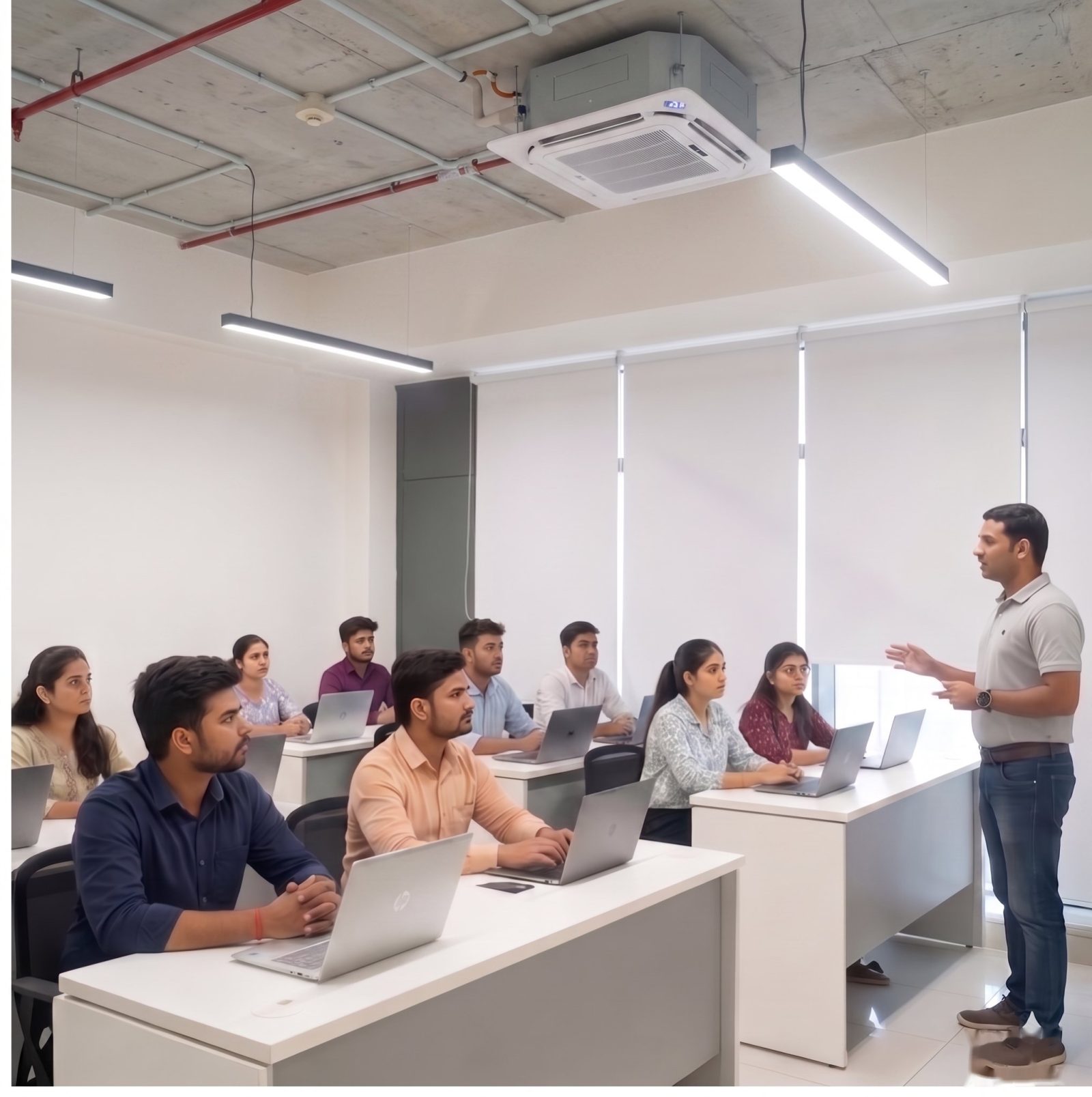
Instructor-led classroom bootcamp in Pune (613, Vision Flora, Pimple Saudagar). Live sessions over 8 weekends — not pre-recorded video content. Online option also available.
Those platforms deliver recorded content with isolated exercises. At MCAL, you build two complete enterprise AI systems under live instructor guidance. You graduate with a GitHub portfolio and working demos.
MCP is the emerging open standard for how AI agents securely communicate with external tools, servers, and data sources. In Module 8, you build and deploy actual MCP servers — a skill barely any course in India covers.
Yes. Module 9 is dedicated to Amazon Bedrock — you build a live cloud-hosted Generative AI application using S3 and Aurora PostgreSQL.
Call +91 97505 95595 or email info@mcal.global. You can also visit us at 613, Vision Flora, Pimple Saudagar, Pune.

Your Next Step

Ready to Become an Enterprise
Agentic AI Developer?

In 8 weekends, go from Python developer to enterprise Agentic AI engineer.

53 hours · 10 modules · 2 enterprise applications · Certification
+91 97505 95595 · info@mcal.global · 613, Vision Flora, Pimple Saudagar, Pune